
Abstract
Introduction: To evaluate ureter-level factors associated with clinical outcome after endoscopic injection in children with primary vesicoureteral reflux (VUR), and to describe radiologic recurrence in the subgroup with postoperative voiding cystourethrography (VCUG).
Materials and Methods: This single-center retrospective study included children older than 2 years who underwent endoscopic subureteric injection for primary VUR between October 2023 and January 2025. Patients with neurogenic bladder, clinically apparent bladder dysfunction, or postvoid residual urine volume greater than 20 mL were excluded. Clinical success was defined as the absence of febrile urinary tract infection during the first 12 postoperative months. Radiologic recurrence was assessed only in ureters with postoperative VCUG. Ureter-level analyses were performed using generalized estimating equations (GEE) to account for within-patient clustering.
Results: Eighty children (59 girls, 21 boys; mean age 7.25±3.17 years) comprising 107 refluxing ureters were treated. Mean follow-up was 19.31±8.66 months. Clinical success was achieved in 65.4% of ureters after the first injection and reached 69.2% with additional injections. Cystoscopic ureteral orifice morphology was significantly associated with clinical outcome, with higher success in horseshoe-type than in golf-hole and stadium-type orifices. Among 33 ureters with postoperative VCUG, radiologic recurrence was observed in 19 (57.6%).
Conclusion: In selected children with primary VUR, endoscopic injection was associated with infection-free outcomes at the ureter level, although the response varied between ureters. Clinical outcome differed according to ureteral orifice morphology. Because postoperative imaging was available only in a selected subgroup, radiologic findings should be interpreted with caution.
Keywords: Vesico-ureteral reflux, child, endoscopy, ureteral orifice
Introduction
Vesicoureteral reflux (VUR) is one of the most common urinary tract abnormalities in childhood and retains its clinical importance because of its association with recurrent febrile urinary tract infection (UTI), renal parenchymal injury, and, in a subset of children, progressive decline in renal function. VUR is no longer viewed simply as an anatomic disorder of retrograde urine flow. It is now recognized as a heterogeneous clinical condition that must be interpreted alongside reflux grade, infection burden, associated urinary tract anomalies, and bladder-bowel function. Accordingly, current guidelines place risk-based patient selection at the centre of management (-).
Management options for primary VUR include observation, antibiotic prophylaxis, endoscopic injection, and ureteral reimplantation. Of these, endoscopic subureteric injection has gained wide acceptance in pediatric urology owing to its minimally invasive nature, low morbidity, and short hospital stay. The patient subgroup most likely to benefit from this approach, and the relative contribution of variables that influence treatment outcome, are nevertheless still incompletely defined. Earlier work has implicated reflux grade, laterality, duplex collecting system, differential renal function, and cystoscopic ureteral orifice morphology, but the findings have remained heterogeneous and at times contradictory (-).
An important methodological limitation of the existing literature is the inclusion of clinically heterogeneous populations. Neurogenic bladder, clinically meaningful bladder-bowel dysfunction, and elevated postvoid residual urine volume may each influence both the natural course of the disease and its response to intervention. Analyses confined to more homogeneous cohorts may therefore offer a clearer view of the factors associated with outcome after endoscopic treatment (-,,).
In everyday practice, treatment success cannot be reduced to radiologic resolution alone. Prevention of febrile UTI and avoidance of further intervention are at least as meaningful to patients and families as imaging findings, and many contemporary series no longer perform postoperative voiding cystourethrography (VCUG) routinely. As a consequence, radiologic data often reflect a selected subgroup rather than the whole treated population (,,,,).
Against this background, we evaluated factors associated with clinical outcome after endoscopic injection in children with primary VUR who did not have neurogenic bladder, evident voiding dysfunction, or elevated postvoid residual urine volume. Radiologic recurrence was additionally examined in a descriptive fashion within the subgroup of ureters with available postoperative VCUG.
Materials and Methods
Study Design and Patient Selection
This single-center retrospective observational study included pediatric patients who underwent endoscopic subureteric injection for primary VUR between October 2023 and January 2025. All procedures were performed by a single experienced pediatric urologist; accordingly, both the operative technique and the cystoscopic classification of ureteral orifice morphology were uniform throughout the study period, thereby eliminating inter-operator variability as a source of heterogeneity.
Eligible patients were children older than 2 years with primary VUR who underwent endoscopic injection and had postoperative follow-up data available. Patients with neurogenic bladder, clinically evident bladder dysfunction, or postvoid residual urine volume greater than 20 mL were excluded. Preoperative lower urinary tract function was assessed in accordance with International Children’s Continence Society (ICCS) recommendations using a 2-day voiding diary, uroflowmetry, and postvoid residual measurement. Only patients without clinical or functional evidence of dysfunctional voiding were included, yielding a relatively homogeneous cohort free from neurogenic bladder and clinically meaningful voiding dysfunction. Only toilet-trained children between 2 and 13 years of age were included in the study. All patients received continuous antibiotic prophylaxis for at least 6 months after endoscopic injection. In patients who developed postoperative febrile UTI, prophylaxis was continued for a minimum of 12 months.
The ureter was used as the unit of analysis. In patients with bilateral VUR, each refluxing ureter was recorded separately. Because ureters from the same patient are not statistically independent, within-patient correlation was addressed in the statistical analysis. Demographic and general clinical variables were summarised at the patient level, whereas treatment-related comparisons and outcome analyses were performed at the ureter level.
Data Collection and Variables
Data were retrieved retrospectively from medical records and the electronic hospital information system. Recorded variables included age, sex, VUR grade, laterality, duplex collecting system status, date of surgery, and postoperative follow-up duration. Baseline renal status was assessed by DMSA scintigraphy, and differential renal function was recorded separately for the right and left kidneys.
Treatment-related baseline variables included injection material, injection technique, and cystoscopic ureteral orifice morphology. Two commercially available dextranomer/hyaluronic acid (Dx/HA) copolymer formulations were used and analysed as formulation A and formulation B rather than by trade name. Injection technique was classified as STING or double HIT, the latter involving sequential injections within the intramural ureter to achieve coaptation along the ureteral tunnel. Based on operative records, ureteral orifice morphology was classified as slit-like, stadium, horseshoe, or golf-hole. Because no ureter with slit-like morphology was identified in the cohort, comparative analyses were restricted to the stadium, horseshoe, and golf-hole subgroups.
The total number of injections was not treated as a baseline predictor because it reflects reintervention during the treatment course rather than a pre-existing patient- or ureter-level characteristic. It was therefore excluded from the primary predictor analyses and is reported descriptively only. Reflux grade, injection material, injection technique, ureteral orifice morphology, and clinical and radiologic outcomes were recorded and analysed separately for each refluxing ureter.
Serum creatinine level and antibiotic prophylaxis were recorded to characterise the renal and clinical profile of the cohort. As part of standard care, all patients received postoperative antibiotic prophylaxis for at least 6 months.
DMSA Assessment
Differential renal function of the right and left kidneys was recorded separately from DMSA scintigraphy and presented as a baseline renal characteristic in descriptive analyses. In patients with unilateral VUR, differential renal function of both the injected and the contralateral kidneys was additionally documented. In ureter-based analyses, the DMSA differential renal function of the kidney drained by the refluxing ureter was used.
Outcome Measures
The primary clinical outcome was clinical success, defined as the absence of febrile UTI during the first 12 postoperative months. Ureters associated with at least one febrile UTI during this period were classified as clinical failures. A minimum follow-up of 12 months was required for all ureters included in the clinical outcome analysis. The 12-month assessment window was specified before analysis. Febrile UTI after endoscopic correction occurs predominantly within the first postoperative year, and a fixed observation period allowed clinical outcome to be compared on equal terms across patients whose total follow-up differed considerably. Episodes occurring after the twelfth postoperative month were recorded but were not treated as outcome events and did not alter the classification of clinical success or failure.
Febrile UTI is a patient-level event, and the responsible ureter cannot be identified on clinical grounds alone. In children with bilateral reflux, therefore, an infection episode was assigned to both refluxing ureters rather than to a presumed affected side. This rule was applied without exception, so that clinical outcome status was necessarily concordant between the two ureters of every bilateral patient.
The secondary outcome was radiologic recurrence after surgery. This analysis was restricted to ureters with available postoperative VCUG, and cases were categorised as recurrence present or absent according to imaging findings. Postoperative VCUG was obtained selectively rather than according to a protocol; it was most often requested after postoperative febrile UTI or when recurrence was clinically suspected, and less commonly because of outside-center imaging or family request. The resulting proportions therefore should not be read as an incidence estimate for the entire cohort but as a ureter-level evaluation within a selected imaging subgroup.
Follow-up
Follow-up duration was calculated as the interval, in months, between the date of surgery and the most recent clinical contact in the hospital information system. The last clinical contact was defined as the most recent record of any clinical interaction, including outpatient visit, laboratory test, or imaging. Clinical outcome analyses were limited to cases with at least 12 months of follow-up.
Statistical Analysis
Analyses were performed at the ureter level. Because some children contributed more than one ureter, within-patient clustering was accounted for in regression analyses using generalized estimating equations (GEE) with robust standard errors. Descriptive data are presented as mean ± standard deviation, median (interquartile range), or number (percentage), as appropriate. Group comparisons used the chi-square test or Fisher’s exact test for categorical variables and the Student t-test, Mann-Whitney U test, one-way analysis of variance, or Kruskal-Wallis test for continuous variables, according to data distribution.
Variables selected on clinical grounds and supported by univariable assessment were entered into multivariable models, with model complexity kept limited in view of sample size. To preserve an adequate events-per-variable ratio, no more than three predictors were entered into each model given the number of clinical failure events in the primary outcome analysis. Missing data were minimal and occurred at random; no imputation was performed. Clinical outcome and radiologic recurrence were evaluated with cluster-adjusted logistic models. Because of the modest sample size and the limited distribution of some variables across categories, estimates were interpreted cautiously, with emphasis on effect estimates and confidence intervals rather than P values alone. Because cystoscopic ureteral orifice morphology and preoperative reflux grade were closely related, a prespecified sensitivity model was fitted in which preoperative VUR grade was added to the clinical failure model as a covariate, in order to determine whether the association between orifice morphology and clinical failure persisted after adjustment for reflux severity. Reflux grade was modelled both as a continuous variable (per one-grade increase) and dichotomously (grade 4-5 vs. grade 2-3). All tests were two-sided and p<0.05 was considered statistically significant. Statistical analyses were performed with IBM SPSS Statistics, version 25.0 (IBM Corp., Armonk, NY, USA).
Ethical Approval
The study was approved by the Institutional Ethics Committee of University of Health Sciences Turkey, Gaziantep City Hospital (approval no: 150/2025; date: March 19, 2025) and conducted in accordance with the Declaration of Helsinki. Because of the retrospective design, written informed consent was waived by the ethics committee.
Results
A total of 80 children (59 girls and 21 boys; mean age 7.25±3.17 years; mean follow-up 19.31±8.66 months), comprising 107 refluxing ureters, underwent endoscopic treatment. Of these ureters, 54 came from bilateral cases and 53 from unilateral cases (). Clinical success after the first endoscopic injection was achieved in 65.4% of ureters (70/107) and reached 69.2% (74/107) after additional injections ().
Table 1. Baseline patient-level and ureter-level characteristics of the study cohort
Variable | Result |
|---|---|
Patient-level variables | - |
Total number of patients | 80 |
Age, years | 7.25±3.17 |
Female sex, n (%) | 59 (73.8) |
Male sex, n (%) | 21 (26.2) |
Postoperative follow-up, months | 19.31±8.66 |
Right kidney DMSA differential function, % | 45.88±17.07 |
Left kidney DMSA differential function, % | 53.85±16.92 |
Ureter-level variables | - |
Total number of refluxing ureters | 107 |
Ureters from bilateral cases, n (%) | 54 (50.5) |
Ureters from unilateral cases, n (%) | 53 (49.5) |
Ureters with duplex collecting systems, n (%) | 4 (3.7) |
DMSA differential function of the injected kidney, % | 43.84±15.46 |
DMSA: Dimercaptosuccinic acid scintigraphy. Continuous variables are presented as mean ± standard deviation, and categorical variables as number (percentage)
Table 2. Ureter-level unadjusted comparisons according to febrile UTI-free follow-up during the first 12 postoperative months
Variable | Febrile UTI-free follow-up, n/N (%) | Clinical failure, n/N (%) | p |
|---|---|---|---|
Injection material | - | - | 0.495 |
Dx/HA formulation A | 50/75 (66.7) | 25/75 (33.3) | - |
Dx/HA formulation B | 24/32 (75.0) | 8/32 (25.0) | - |
Injection technique | - | - | 0.277 |
STING | 51/70 (72.9) | 19/70 (27.1) | - |
Double HIT | 23/37 (62.2) | 14/37 (37.8) | - |
Ureteral orifice morphology | - | - | 0.005 |
Stadium | 6/11 (54.5) | 5/11 (45.5) | - |
Horseshoe | 30/33 (90.9) | 3/33 (9.1) | - |
Golf-hole | 38/63 (60.3) | 25/63 (39.7) | - |
VUR laterality | - | - | 0.836 |
Ureter from bilateral case | 38/54 (70.4) | 16/54 (29.6) | - |
Ureter from unilateral case | 36/53 (67.9) | 17/53 (32.1) | - |
VUR grade | - | - | 0.235 |
Grade 2 | 7/13 (53.8) | 6/13 (46.2) | - |
Grade 3 | 17/20 (85.0) | 3/20 (15.0) | - |
Grade 4 | 16/22 (72.7) | 6/22 (27.3) | - |
Grade 5 | 34/52 (65.4) | 18/52 (34.6) | - |
Sex (ureter-based) | - | - | 0.633 |
Male ureters | 20/27 (74.1) | 7/27 (25.9) | - |
Female ureters | 54/80 (67.5) | 26/80 (32.5) | - |
Duplex collecting system | - | - | 0.008* |
Absent | 74/103 (71.8) | 29/103 (28.2) | - |
Present | 0/4 (0.0) | 4/4 (100.0) | - |
Age, years (mean ± SD) | 6.91±3.05 | 7.45±3.41 | 0.242 |
Serum creatinine, mg/dL | 0.40±0.20 | 0.38±0.12 | 0.583 |
Prophylaxis duration, months | 10.20±4.95 | 11.91±6.43 | 0.369 |
Differential function of injected kidney (DMSA), % | 43.97±15.71 | 43.55±14.96 | 0.580 |
UTI: Urinary tract infection; VUR: Vesicoureteral reflux; Dx/HA: Dextranomer/hyaluronic acid; DMSA: Dimercaptosuccinic acid scintigraphy; SD: Standard deviation. Febrile UTI-free follow-up was defined as the absence of febrile urinary tract infection during the first 12 postoperative months. P-values are unadjusted. *: Fisher’s exact test. The duplex collecting system comparison should be interpreted with caution because only 4 ureters had duplex anatomy. Dx/HA formulations A and B represent different commercially available dextranomer/hyaluronic acid copolymers.
Cystoscopic ureteral orifice morphology was associated with clinical success. Success rates were 90.9% (30/33) for horseshoe-type orifices, 60.3% (38/63) for golf-hole, and 54.5% (6/11) for stadium-type orifices. This association remained evident after accounting for within-patient clustering. The distribution of preoperative VUR grade within each orifice morphology category is presented descriptively in . Stadium-type orifices were observed only in grade 2-3 reflux, whereas golf-hole orifices were more frequent among grade 5 reflux. No clinical success was observed in the small subgroup of ureters with a duplex collecting system (n=4); given the small sample size, however, this finding should be regarded as preliminary. No significant association was identified between clinical success and injection material, injection technique, age, sex, reflux grade, laterality, serum creatinine level, duration of prophylaxis, or DMSA-derived differential renal function of the injected kidney ().
Table 3. Distribution of preoperative VUR grade according to cystoscopic ureteral orifice morphology (ureter-level, n=107)
Ureteral orifice morphology | Grade 2, n (%) | Grade 3, n (%) | Grade 4, n (%) | Grade 5, n (%) | Total, n |
Stadium | 7 (63.6) | 4 (36.4) | 0 (0.0) | 0 (0.0) | 11 |
Horseshoe | 5 (15.2) | 9 (27.3) | 10 (30.3) | 9 (27.3) | 33 |
Golf-hole | 1 (1.6) | 7 (11.1) | 12 (19.0) | 43 (68.3) | 63 |
Total | 13 (12.1) | 20 (18.7) | 22 (20.6) | 52 (48.6) | 107 |
VUR: Vesicoureteral reflux. Percentages are calculated within each ureteral orifice morphology category (row percentages); percentages in the Total row are calculated across all 107 ureters. Ureteral orifice morphology and preoperative VUR grade were strongly associated [χ2(6) =52.40, p<0.001, chi-square test], with stadium-type orifices concentrated in lower reflux grades and golf-hole orifices concentrated in grade 5. Because of this close association, the relationship between ureteral orifice morphology and clinical failure was further examined in sensitivity models adjusted for preoperative VUR grade.
In cluster-adjusted GEE analysis, ureteral orifice morphology remained associated with clinical failure. Compared with horseshoe-type orifices, stadium-type orifices were associated with higher odds of clinical failure (OR 8.33, 95% CI 1.47-47.17; p=0.017), as were golf-hole type orifices (OR 6.58, 95% CI 1.99-21.76; p=0.002) (). The effect of duplex collecting system could not be reliably estimated because all four duplex ureters experienced clinical failure. In the sensitivity model that additionally included preoperative VUR grade, the association between orifice morphology and clinical failure persisted, whereas reflux grade itself was not associated with outcome. Compared with horseshoe-type orifices, the odds of clinical failure remained increased for golf-hole orifices (OR 7.29, 95% CI 2.17-24.50; p=0.001) and for stadium-type orifices (OR 7.19, 95% CI 0.98-52.55; p=0.052), while VUR grade carried no independent effect (OR 0.89 per one-grade increase, 95% CI 0.51-1.56; p=0.686). Results were materially unchanged when reflux grade was entered dichotomously ().
Postoperative VCUG data were available for 33 ureters (30.8%) (; ). Within this imaging subgroup, radiologic recurrence was observed in 19 ureters (57.6%). Exploratory analyses were performed within this selected subgroup (). No significant association was observed between radiologic recurrence and ureteral orifice morphology, injection material, injection technique, sex, duplex collecting system, or DMSA-derived differential renal function. In unadjusted comparisons, radiologic recurrence appeared more frequent in lower-grade reflux. This finding was considered a consequence of selective postoperative imaging rather than a biologic association, because VCUG was mainly obtained after febrile UTI. Therefore, no effect estimate was reported for VUR grade in the radiologic recurrence model. Laterality did not retain statistical significance in cluster-adjusted GEE analysis (bilateral vs. unilateral: OR 4.29, 95% CI 0.84-21.76; p=0.079) ().
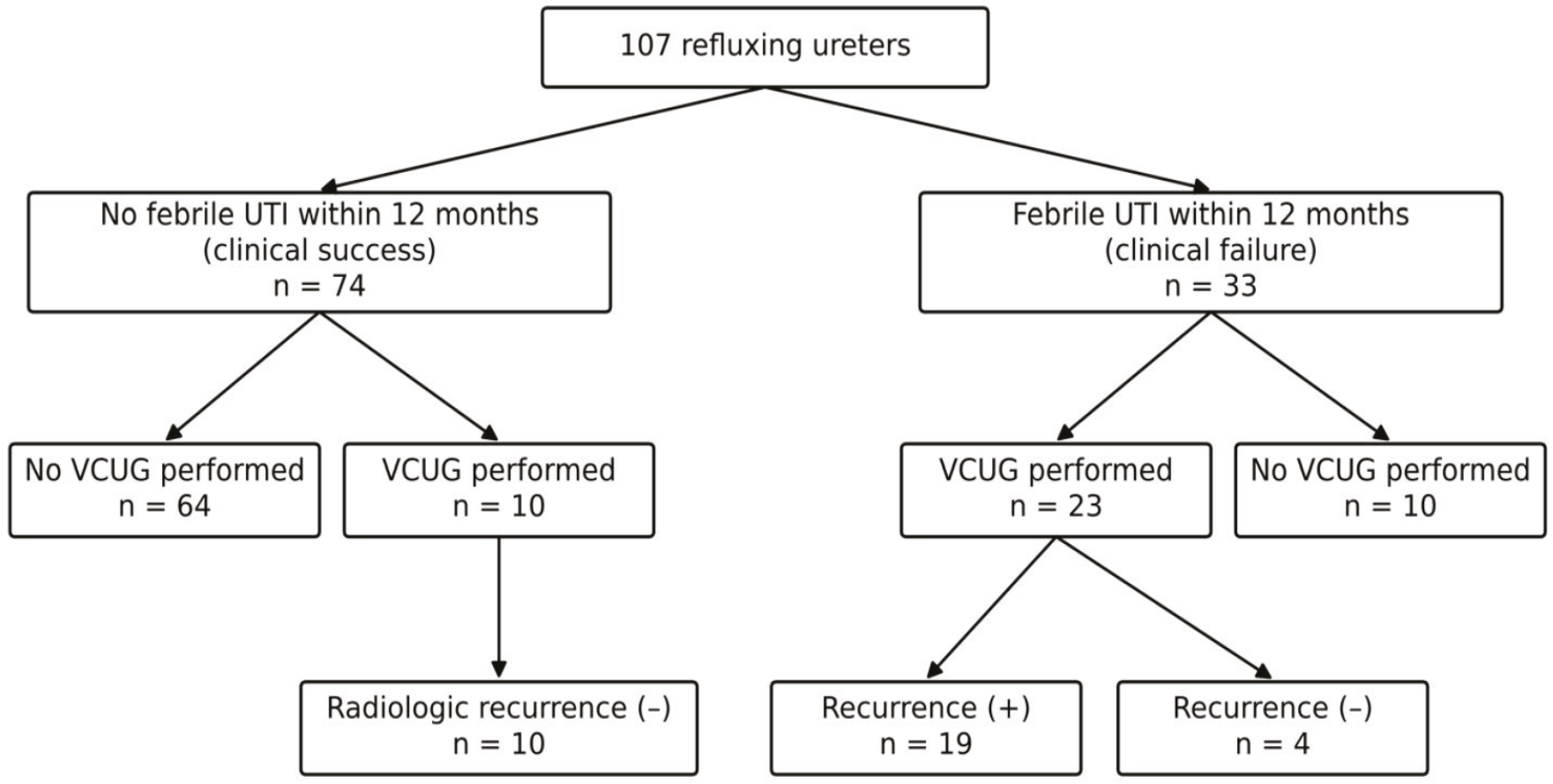
Flow diagram of the 107 refluxing ureters according to clinical outcome (febrile urinary tract infection during the first 12 postoperative months), postoperative voiding cystourethrography (VCUG), and radiologic recurrence. Postoperative VCUG was not protocol-driven; it was obtained mainly after febrile urinary tract infection and, in a smaller number of ureters, because of outside-center imaging or family request. Radiologic recurrence was assessed only in ureters with postoperative VCUG (n=33). UTI: Urinary tract infection
Table 4. Exploratory ureter-level analysis of radiologic recurrence among ureters with available postoperative VCUG
Variable | Recurrence, n/N (%) | No recurrence, n/N (%) | p |
|---|---|---|---|
Injection material | - | - | 0.238 |
Dx/HA formulation A | 16/25 (64.0) | 9/25 (36.0) | - |
Dx/HA formulation B | 3/8 (37.5) | 5/8 (62.5) | - |
Injection technique | - | - | 0.459 |
STING | 14/22 (63.6) | 8/22 (36.4) | - |
Double HIT | 5/11 (45.5) | 6/11 (54.5) | - |
Ureteral orifice morphology | - | - | 0.161 |
Stadium | 4/4 (100.0) | 0/4 (0.0) | - |
Horseshoe | 3/7 (42.9) | 4/7 (57.1) | - |
Golf-hole | 12/22 (54.5) | 10/22 (45.5) | - |
VUR laterality | - | - | 0.049 |
Ureter from bilateral case | 12/16 (75.0) | 4/16 (25.0) | - |
Ureter from unilateral case | 7/17 (41.2) | 10/17 (58.8) | - |
VUR grade | - | - | 0.022 |
Grade 2 | 5/5 (100.0) | 0/5 (0.0) | - |
Grade 3 | 3/4 (75.0) | 1/4 (25.0) | - |
Grade 4 | 1/7 (14.3) | 6/7 (85.7) | - |
Grade 5 | 10/17 (58.8) | 7/17 (41.2) | - |
Sex (ureter-based) | - | - | 0.620 |
Male ureters | 3/4 (75.0) | 1/4 (25.0) | - |
Female ureters | 16/29 (55.2) | 13/29 (44.8) | - |
Duplex collecting system | - | - | 0.561 |
Absent | 18/30 (60.0) | 12/30 (40.0) | - |
Present | 1/3 (33.3) | 2/3 (66.7) | - |
Age, years (mean ± SD) | 7.68±2.78 | 6.36±2.73 | 0.280 |
Differential function of injected kidney (DMSA), % | 42.53±14.85 | 44.36±17.27 | 0.511 |
VCUG: Voiding cystourethrography; VUR: Vesicoureteral reflux; Dx/HA: Dextranomer/hyaluronic acid; DMSA: Dimercaptosuccinic acid scintigraphy; UTI: Urinary tract infection; SD: Standard deviation. P-values are unadjusted. In cluster-adjusted generalized estimating equation analysis, the association between VUR laterality and radiologic recurrence was no longer statistically significant. The comparison by VUR grade is shown for completeness only, since postoperative VCUG was selectively obtained, mainly after febrile UTI; the observed pattern reflects imaging indication rather than a reliable association with recurrence. Dx/HA formulations A and B represent different commercially available dextranomer/hyaluronic acid copolymers.
Among ureters with postoperative VCUG data, clinical failure and radiologic recurrence tended to occur together, but the overlap was incomplete. A small subset of ureters showed clinical failure despite the absence of radiologic recurrence, indicating that febrile UTI is an imperfect surrogate for persistent VUR and that clinical and radiologic endpoints do not fully overlap ().
Discussion
In this selected cohort of children with primary VUR who did not have neurogenic bladder, clinically evident voiding dysfunction, or elevated postvoid residual urine volume, endoscopic injection was associated with clinically meaningful infection-free outcomes at the ureter level. Clinical success was achieved in 65.4% of ureters after the first injection and reached 69.2% after additional injections. These findings support a continuing role for endoscopic treatment in appropriately selected patients and broadly align with contemporary risk-adapted approaches to reflux management (-,-).
A particular strength of this study is the deliberate exclusion of major lower urinary tract confounders. Interpretation of endoscopic outcomes is often complicated when cohorts include children with neurogenic bladder, clinically meaningful bladder-bowel dysfunction, or elevated postvoid residual urine volume, all of which may influence both the natural course of the disease and the response to intervention. Excluding these factors provided a more focused assessment of ureter-level features associated with outcome after endoscopic correction and may partly explain differences from more heterogeneous series (-,,,).
One of our principal findings was the association between cystoscopic ureteral orifice morphology and clinical outcome. Horseshoe-type orifices yielded the most favourable infection-free outcomes, whereas golf-hole and stadium-type orifices were associated with lower success rates. The persistence of this association after adjustment for within-patient clustering suggests that cystoscopic morphology reflects a clinically relevant anatomic phenotype rather than simply an intraoperative descriptor. Previous studies have likewise linked ureteral orifice configuration to reflux severity and endoscopic outcome (,,-). The finding should nevertheless be interpreted with caution given the small number of stadium-type ureters, the subjective nature of morphologic classification, and the absence of a strictly ordered gradient across categories. Orifice morphology and preoperative reflux grade were closely related in our cohort, raising the question of whether the morphologic effect merely reflected reflux severity. When reflux grade was added to the model, however, the association between orifice morphology and clinical failure persisted, whereas grade itself contributed no independent information. Because the association was independent of reflux grade, cystoscopic orifice configuration is best regarded as a distinct prognostic marker rather than a surrogate for reflux severity, and it may add clinically useful information at the time of cystoscopy that standard radiologic grading does not capture. This inference rests chiefly on the golf-hole comparison, which was robust to adjustment; the stadium-type estimate lost precision after adjustment and warrants confirmation in larger cohorts.
No significant association was identified between clinical outcome and reflux grade, laterality, injection material, injection technique, serum creatinine level, duration of prophylaxis, or DMSA-derived differential renal function. Although earlier studies have implicated higher reflux grade, adverse renal functional parameters, duplex anatomy, or procedural factors in lower success rates, the evidence across cohorts has been inconsistent (-,-). The absence of similar associations in our series may reflect the clinically selected nature of the cohort, the small size of some subgroups, and the use of infection-free follow-up rather than radiologic resolution as the primary endpoint.
The lack of clinical success among the four ureters with duplex collecting systems is noteworthy, but this subgroup is far too small to support a reliable inference and should be treated strictly as a preliminary signal. A similarly cautious view applies to technical variables: neither injection material nor injection technique was associated with outcome, in keeping with reports suggesting that treatment response may depend more on reflux phenotype and ureteral anatomy than on procedural choice alone (,-).
Radiologic findings warrant particular caution. Postoperative VCUG was available for only 33 ureters, and radiologic recurrence was identified in 57.6% of this imaged subgroup. Because imaging was not obtained according to a standardised protocol, this proportion should not be read as the prevalence of recurrence in the overall cohort. The imaged subgroup was likely clinically selected, with postoperative VCUG most often performed after postoperative infection and only occasionally for non-protocol reasons. This limitation is especially relevant given that many contemporary series do not perform routine postoperative VCUG in all patients (,,,,).
This interpretation is reinforced by the pattern of the recurrence analysis. Although some variables appeared associated with radiologic recurrence in unadjusted comparisons, the estimates were not stable enough to support a firm inference. In particular, the apparent inverse association between preoperative VUR grade and radiologic recurrence should be interpreted as a consequence of selective imaging. Because postoperative VCUG was most often obtained after clinical failure, low-grade ureters were overrepresented in the imaged subgroup when infection had occurred. Accordingly, this pattern should not be interpreted as evidence that lower reflux grade increases the risk of radiologic recurrence.
The relationship between clinical and radiologic outcomes also deserves emphasis. Among ureters with postoperative VCUG data, clinical failure and radiologic recurrence frequently co-occurred, but the overlap was incomplete. Some ureters showed clinical failure despite the absence of radiologic recurrence, indicating that febrile UTI is an imperfect surrogate for persistent VUR. Clinical and radiologic outcomes are therefore related but not interchangeable, and a multidimensional definition of treatment success after endoscopic correction is warranted (,,,,).
A further strength of the study is its ureter-level analytical framework. Because reflux grade, ureteral anatomy, cystoscopic findings, and injection-related variables are inherently ureter-specific, analysis at the level of the refluxing unit offers greater clinical resolution than patient-level aggregation alone. Within-patient correlation in bilateral cases was addressed using GEE, allowing us to preserve ureter-level detail while accounting for the non-independence of observations.
Study Limitations
Several limitations should be acknowledged. The retrospective single-center design introduces the possibility of unmeasured confounding and limits the standardisation of follow-up. Several clinically relevant subgroups were small, particularly duplex systems, stadium-type ureters, and the subgroup with postoperative VCUG, reducing the stability of subgroup-specific estimates. Ureteral orifice morphology was classified by the operating surgeon without a formal inter-rater reliability assessment, which limits reproducibility. Finally, since the cohort was intentionally restricted to children without major lower urinary tract confounders, the findings should not be generalised uncritically to broader VUR populations.
From a clinical perspective, cystoscopic ureteral orifice morphology may contribute to preoperative risk assessment in children considered for endoscopic correction. Patients with horseshoe-type orifices may be counselled about more favourable expected outcomes, whereas those with golf-hole or stadium-type orifices may benefit from more intensive follow-up or earlier consideration of alternative interventions. Taken together, these findings support a phenotype-oriented approach to patient selection, in which ureteral characteristics may add to risk assessment beyond conventional factors, and suggest that outcome is driven more by ureteral phenotype than by procedural or patient-level factors alone. Larger prospective studies with standardised postoperative assessment and protocol-driven imaging are needed to validate these observations.
Conclusion
In selected children with primary VUR, endoscopic injection was associated with infection-free outcomes at the ureter level, although treatment response varied across ureters. Ureteral orifice morphology was associated with clinical outcome and may help refine the interpretation of treatment response. Radiologic findings should be interpreted with caution because postoperative VCUG was available only in a selected subgroup. Clinical and radiologic outcomes did not fully overlap, supporting the use of complementary endpoints when assessing treatment success after endoscopic correction.
Ethics
Ethics Committee Approval: The study was approved by the Institutional Ethics Committee of University of Health Sciences Turkey, Gaziantep City Hospital (approval no: 150/2025; date: March 19, 2025) and conducted in accordance with the Declaration of Helsinki.
Informed Consent: Because of the retrospective design, written informed consent was waived by the ethics committee.
Footnotes
Acknowledgments
We thank the nursing staff of our hospital for their valuable assistance during the study.
A large language model-based assistant (Claude, Anthropic) was used for language editing of the English text. It was not used for study design, data collection, statistical analysis, or the preparation of tables and figures; all statistical analyses were performed with IBM SPSS Statistics. The authors reviewed all edited text and take full responsibility for the content of the manuscript.
Authorship Contributions
Surgical and Medical Practices: D.Y., Concept: D.Y., Design: D.Y., Data Collection or Processing: D.Y., Z.A., Analysis or Interpretation: D.Y., Literature Search: D.Y., Writing: D.Y., Z.A.
Conflict of Interest
No conflict of interest was declared by the authors.
Financial Disclosure
The authors declared that this study received no financial support.
References
Gnech M, t Hoen L, Zachou A, Bogaert G, Castagnetti M, O’Kelly F, et al. Update and summary of the European Association of Urology/European Society of Paediatric Urology paediatric guidelines on vesicoureteral reflux in children. Eur Urol. 2024;85:433-42.
Puri P, Friedmacher F, Farrugia MK, Sharma S, Esposito C, Mattoo TK. Primary vesicoureteral reflux. Nat Rev Dis Primers. 2024;10:75.
Hari P, Meena J, Kumar M, Sinha A, Thergaonkar RW, Iyengar A, et al. Evidence-based clinical practice guideline for management of urinary tract infection and primary vesicoureteric reflux. Pediatr Nephrol. 2024;39:1639-68.
Lanfranchi G, Paraboschi I, Pierucci UM, Mantica G, Costanzo S, Marinoni F, et al. Efficacy of three different injection techniques for the endoscopic treatment of vesicoureteral reflux (VUR) in children: a review of 10 years of experience. Res Rep Urol. 2024;16:151-9.
Nascimben F, Talon I, Maldonado C, Angotti R, Molinaro F, Moog R, et al. Recurrence of vesico-ureteral reflux in children: is still the endoscopic injection the best option? Transl Androl Urol. 2024;13:1446-54.
Yilmaz IO, Akdogan N, Deger M, Aridogan IA, Izol V, Satar N. Predictors of reflux persistence after endoscopic dextranomer/hyaluronic acid copolymer injection in pediatric patients with vesicoureteral reflux: short-term results. Sci Rep. 2024;14:15252.
Zvizdic Z, Catic A, Zivojevic S, Jonuzi A, Glamoclija U, Vranic S. The correlation between ureteric orifice morphology and primary vesicoureteral reflux grade and the impact on the effectiveness of endoscopic reflux correction. J Pediatr Urol. 2024;20:295-301.
Baltrak YA, Akdogan N, Deger M, Izol V, Aridogan IA, Satar N. An evaluation of ureteral diameter ratio and vesicoureteral reflux index in the treatment of primary vesicoureteral reflux. Asian J Urol. 2024;11:437-42.
Krishnan N, Agarwal P, Verma A, Sharma S, Yadav DK, Kandasamy D, et al. Utility of ureteral diameter ratio for clinical decision-making in children with vesicoureteral reflux: a systematic review and meta-analysis. Pediatr Surg Int. 2024;40:296.
Yücel ÖB, Tekin A, Tiryaki S, Avcı D, Özel Y, Ulman İ. Predictability of success of endoscopic vesicoureteral reflux treatment utilizing clinical risk factors and intraoperative injection characteristics. J Pediatr Urol. 2025;21:1336-41.
Cooper CS, Orzel J, Bonnett MA, Malicoat JR, Hlas AC, Lockwood GM, et al. The significant impact of the distal ureteral diameter ratio as predictor of breakthrough urinary tract infections in children with vesicoureteral reflux. J Pediatr Urol. 2025;21:704.e1-704.e7.
Arlen AM, Leong T, Kirsch AJ, Cooper CS. Spontaneous vesicoureteral reflux resolution curves based on ureteral diameter ratio. J Pediatr Urol. 2023;19:468.e1-468.e6.
Kopac M. Pediatric lower urinary tract dysfunction: a comprehensive exploration of clinical implications and diagnostic strategies. Biomedicines. 2024;12:945.
Alyasi AS, Alsaad DB, Alshammary EM, Abdulrahman AA, Ghazwani MH, Almuayrifi MJ, et al. Understanding and managing pediatric urinary tract infections in vesicoureteral reflux: insights into pathophysiology and care. Cureus. 2024;16:e76144.
Nascimben F, Molinaro F, Maffi M, Nino F, Lachkar A, Zislin M, et al. Endoscopic injection vs anti-reflux surgery for moderate- and high-grade vesicoureteral reflux in children: a cost-effectiveness international study. J Robot Surg. 2024;18:371.
Escolino M, Kalfa N, Castagnetti M, Caione P, Esposito G, Florio L, et al. Endoscopic injection of bulking agents in pediatric vesicoureteral reflux: a narrative review of the literature. Pediatr Surg Int. 2023;39:133.
Cocomazzi R, Salatto A, Campanella V, Pastore V, Maggipinto C, Aceto G, et al. Bladder dysfunction and re-absorbable bulking agent affect success rate in children underwent endoscopic treatment for vesicoureteral reflux: a long-term follow-up study. Children (Basel). 2021;8:875.
Yap TL, Chen Y, Nah SA, Ong CCP, Jacobsen AS. STING versus HIT technique of endoscopic treatment for vesicoureteral reflux: a systematic review and meta-analysis. J Pediatr Surg. 2016;51:2015-20.
Babu R, Chandrasekharam VVS. A systematic review and meta-analysis comparing outcomes of endoscopic treatment of primary vesicoureteric reflux in children with polyacrylate polyalcohol copolymer versus dextranomer hyaluronic acid. J Pediatr Surg. 2022;57:683-9.
Gholami B, Gholami S, Khodaei B, Sharifiaghdas F. Comparison of polyacrylate polyalcohol copolymer versus dextranomer/hyaluronic acid in endoscopic treatment of vesicoureteral reflux in children: a systematic review and meta-analysis. J Pediatr Urol. 2022;18:664-73.
Supplementary Materials
Supplementary Tables
Download